


You set the goal: lose 10 pounds in 3 months. You built the workout plan. You built the meal plan. You may have even made a little color-coded tracker, because when we commit, we commit. 📊
Three weeks in, you have a “long week”. Worked late every single night, brain fried, body tired, and your gym bag is sitting by the door staring at you like a golden retriever who needs a walk. 🐶
Skipping one day won’t hurt, right? I’ll go tomorrow.
Then tomorrow shows up, and so does the couch. And the couch has a glass of wine, Netflix, and absolutely zero expectations of you. Besides, you’re stressed from the deadline you have at work. So you take the night off. You’ll catch up on the weekend.
Saturday hits and you’re actually going to go. Then you open your plan and it’s that workout. The one that leaves you on the floor. The workout is hard and I don’t want to. And right on cue your friend texts about dinner, and tacos and a margarita sound wayyyy more fun than the gym.
“I’ll reset Monday.”
Two weeks later and you still haven’t “reset”.
So what actually happened?
It’s not what you think.
Meet your caveman brain
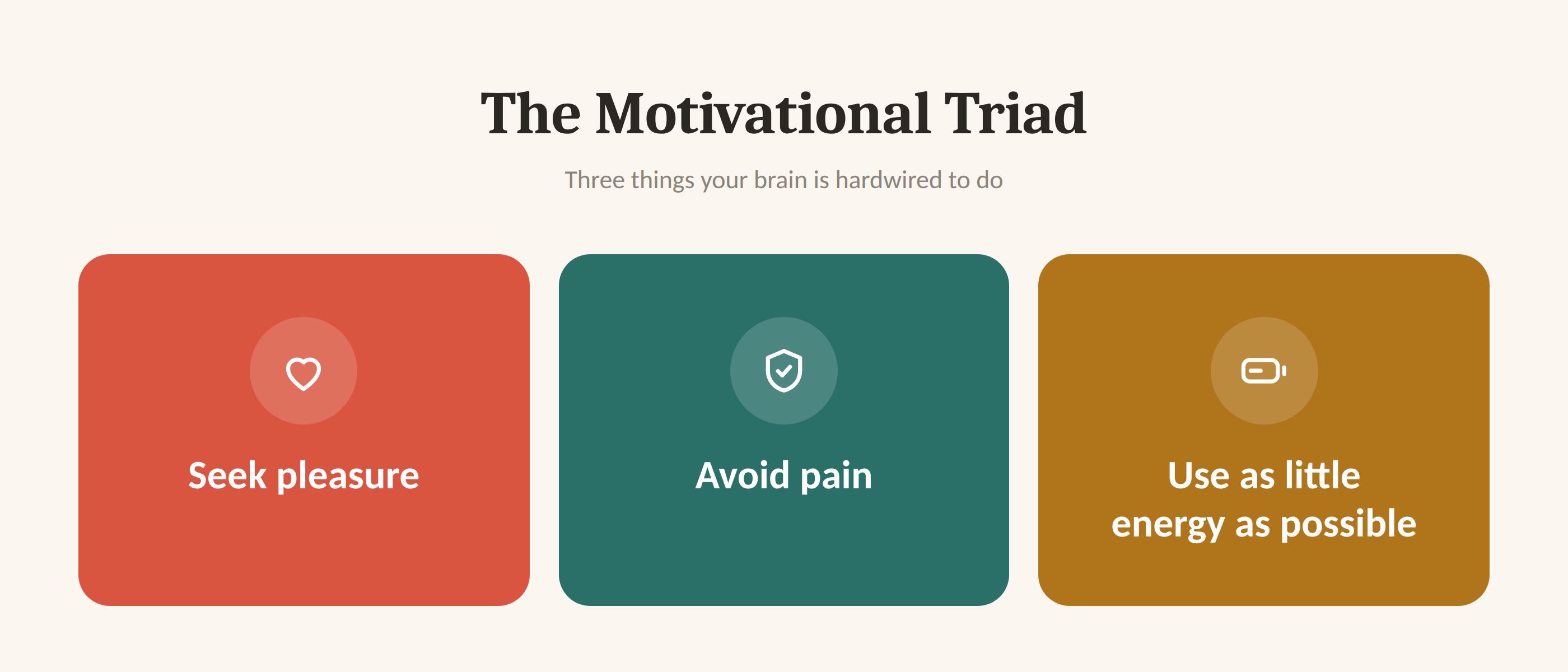
There’s a concept called the motivational triad, and once you see it you cannot unsee it. Three things your brain is hardwired to do:
Seek pleasure
Avoid pain
Use as little energy as possible
Again, this is your cavewoman brain.
And this triad was made to help us. But the problem is, we aren’t cavemen (or women) anymore!
This is how it used to work:
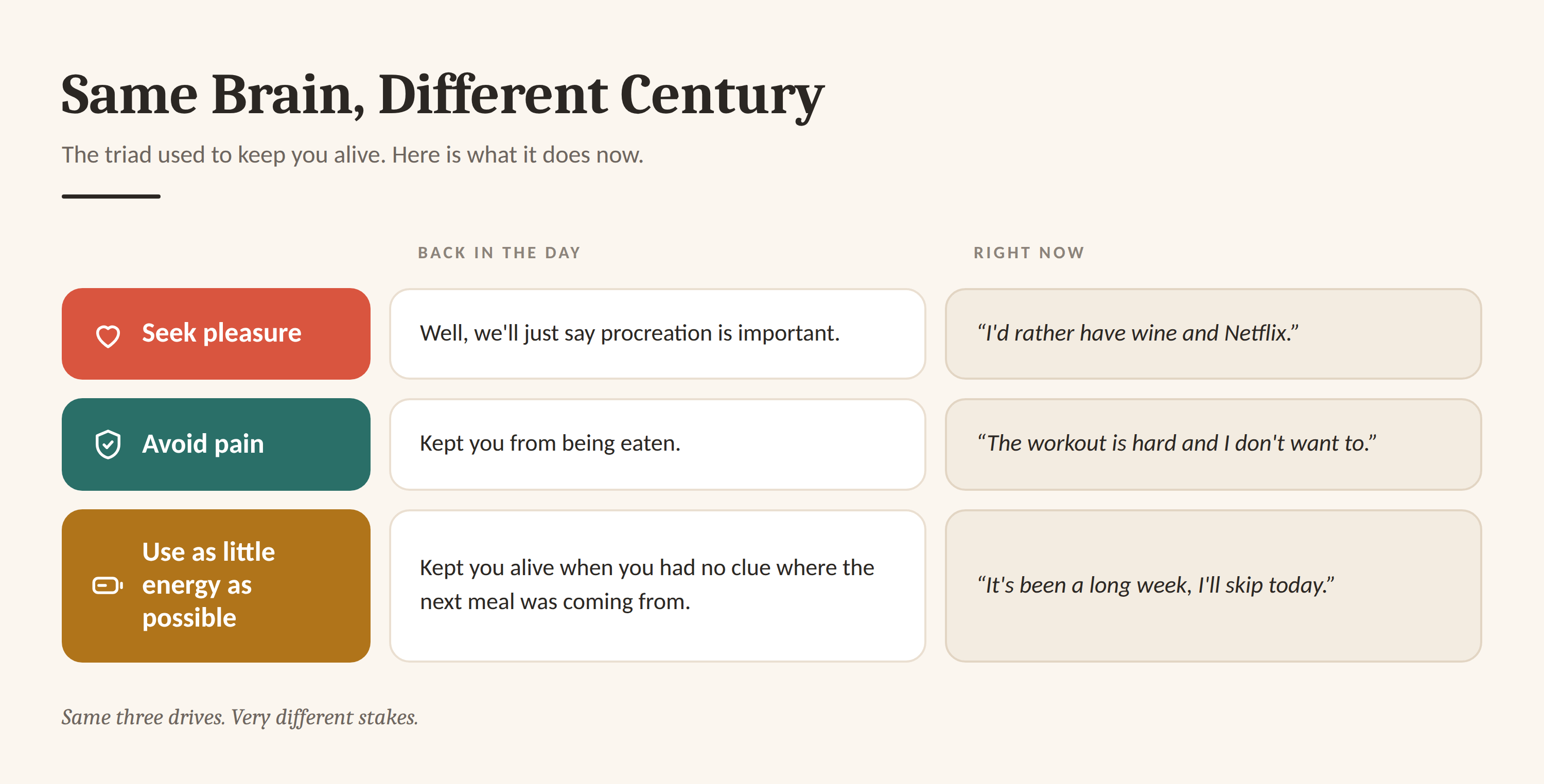
Back in the day, avoiding pain kept you from being eaten
Conserving energy kept you alive when you had no clue where the next meal was coming from.
And seeking pleasure, well, we’ll just say procreation is important
Here’s the problem: you are not a cavewoman. You have a prefrontal cortex, which I like to call your higher brain. It’s the part of you that sets goals, wants to grow, and wants more.
Your higher brain is the one that said “I’m losing 10 pounds in 3 months.”
Your caveman brain is the one that said:
“It’s been a long week, I’ll skip today.” → conserve energy
“I’d rather have wine and Netflix.” → seek pleasure
“The workout is hard and I don’t want to.” → avoid pain
The part nobody warns you about
Setting the goal is the easy part, and quite frankly fun.
But week three, when you’re exhausted and the scale hasn’t changed and the couch is right there?
That’s The Hard Part. It was never the workout, it’s the showing up. Staying committed- because you deserve that.
And here’s what I really want you to hear: if you said you’d work out and you didn’t, that is not a character indictment. Judging yourself is not helpful and shame is a terrible personal trainer.
But it is worth noticing. With curiosity.
Ask: which part of my caveman brain just ran the show?
Before you scroll: if this is landing, subscribe so you get the next one 💌
The 7 steps back
Recognize that nothing has gone wrong. You didn’t fail. Your brain did exactly what brains do. I say to myself “silly brain, of course you want to rest. But that’s not what I’m doing today”. Your caveman brain is trying to help you, but it doesn’t realize it’s actually harming you. This is where you use your higher brain to remind yourself, it’s ok.
Get curious, not cruel. Ask why you didn’t follow through, and actually answer it. Pleasure, pain, or energy? Name which one it was. You cannot outsmart a pattern you refuse to look at. Plus, this will help you override it moving forward.
Expect the caveman brain to show up. Your caveman brain will always sound more appealing in the moment. It will always win if you let it. This isn’t a bug you fix once, it’s a skill to see when it appears and learn to say “not today”.
Notice who’s driving, then take the wheel back. When you catch the caveman brain mid-sentence (“It’s too hard”, “I want to watch Netflix”), that’s your cue to hand the mic back to your higher brain. Why did you set the goal to lose 10 pounds in the first place? How can I show up at least a little bit?
Motivation was never the requirement. Here’s my most controversial opinion: you’re not supposed to always want to do it. There will be days you are driving to the gym and you don’t want to be there. That’s normal. That’s most days, actually. Waiting to feel motivated is like waiting for the weather to be perfect before you leave the house. Sometimes you just have to be disciplined.
Discipline is keeping your word to yourself. You said you’d show up, so you show up. Discipline is doing what you said you were going to do- no matter what. And the beautiful part: the more you practice it, the easier it gets. The first few times are challenging, but it’s a muscle you can build.
Delayed gratification is just better. Instant gratification is a snack. Tastes great, but never fully satisfying. Delayed gratification is the full meal. The wine and Netflix feel great for two hours- they give you instant gratification. Becoming someone who follows through and reaches their goal of losing 10 pounds- that’s delayed gratification. It takes longer, but the satisfaction is so much sweeter.
Reflection questions ✨

Grab a notebook and answer these questions.
The last time you didn’t follow through, which part of the triad was in charge? Pleasure, pain, or energy?
What did you make it mean about you? And is that thing true, or just familiar?
What does your caveman brain typically say right before you skip? Write the exact sentence.
What’s one sentence your higher brain can say back the next time you don’t want to follow through?
Where in your life are you already disciplined? Why?
What’s the smallest promise you could keep to yourself this week that you’re 100% certain you can keep? Keep it.
What becomes possible in six months if you stop needing to feel motivated first?
You don’t need a fresh start. You don’t need Monday. You need to notice who’s talking, and then go anyway. 💪