

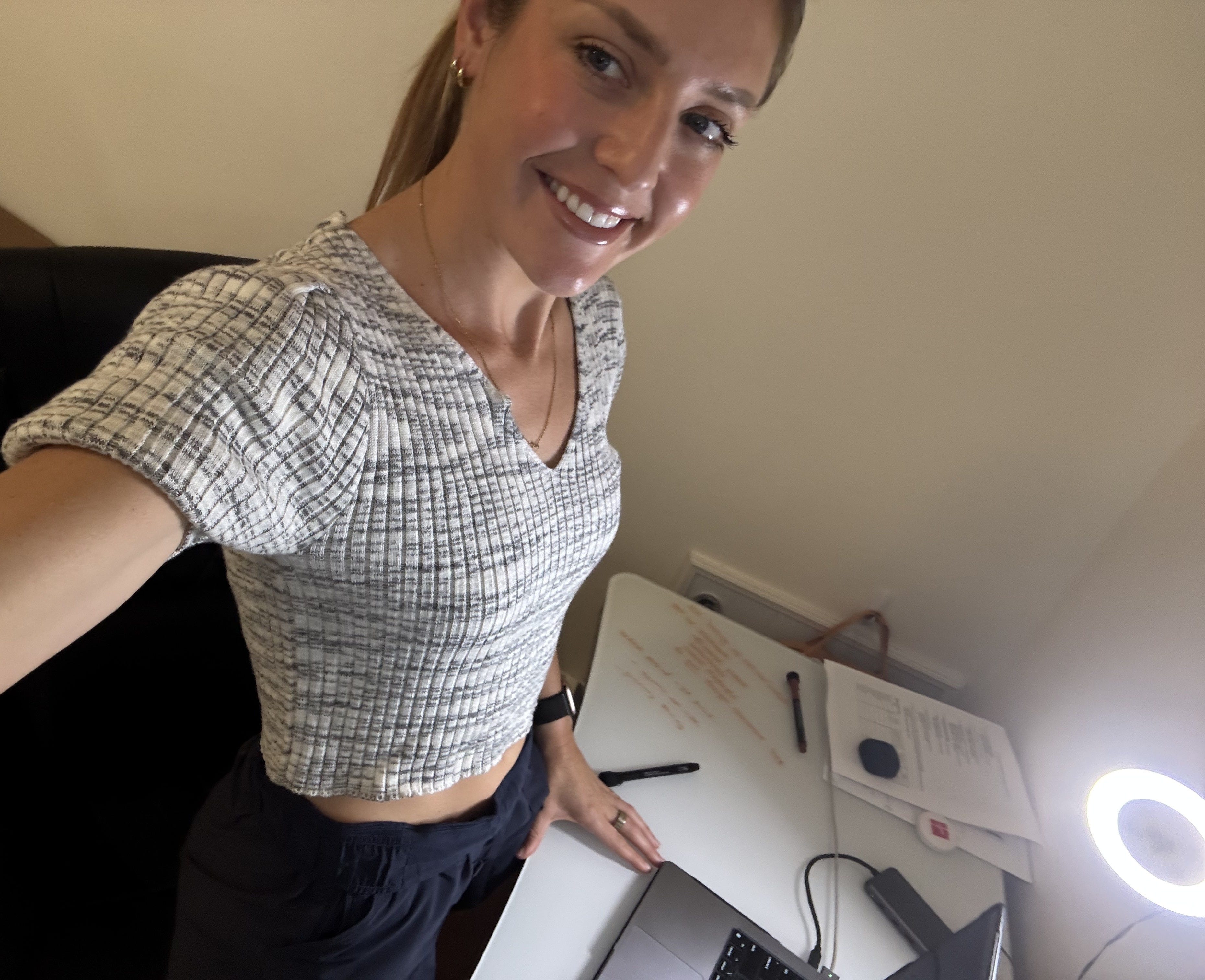
Everyone told me the medical field was the safe bet. Stable, recession proof, “people will always get sick, Brooke.”
Then I got laid off from my job as a Physician Assistant and learned that stability is more of a vibe than a guarantee. 😅
But it didn’t send me into a spiral the way it would have a few years ago. I immediately knew it was time for something bigger and better, as long as I let myself go there.
And I started dreaming. I have nothing holding me back but my own self, so what is it I actually want to do? What kind of big, impossible goals can I set now?
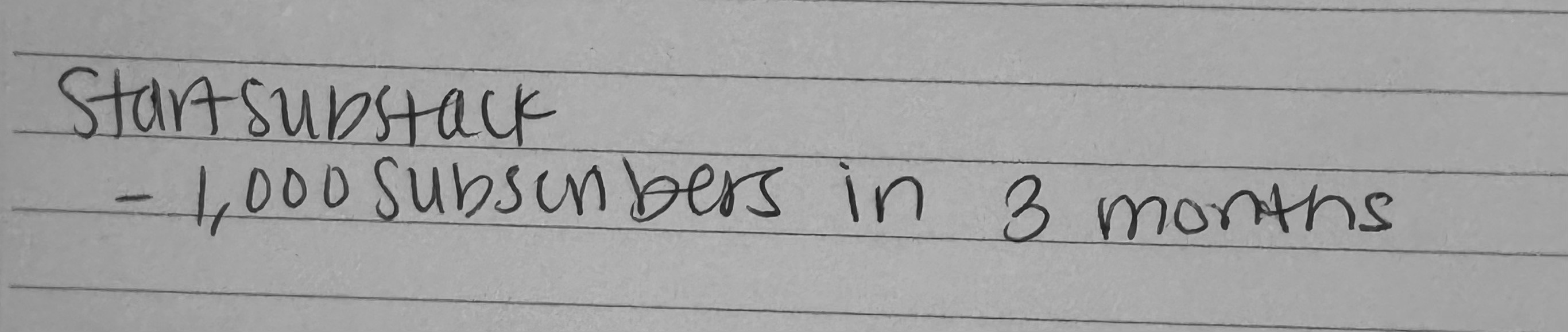
Here’s what I realized. I didn’t just want the next job I could find. I wanted something that was mine. I wanted to build community. So I set a goal that made my stomach drop a little when I said it out loud: build a Substack with 1,000 subscribers within 3 months.
Which, if you know me at all, is objectively funny. I am a math and science girl. Numbers, labs, systems, protocols. I was never the girl with the annotated novels and the little tabs sticking out of the pages. Writing articles for strangers on the internet is... far fetched for this science nerd.
But here we are, showing up and doing the damn thing.
And that’s kind of the whole point of this article.
Why big goals actually matter (spoiler: it’s not about the goal)
Here’s the part nobody says out loud: the goal itself is almost beside the point.
When you set a goal that’s way bigger than your current life, you can’t reach it as the person you are right now. You have to do things you’ve never done. Learn things you don’t currently know. Be bad at something for a while. Which means you have to become a different, more evolved version of yourself just to get there.
That’s the actual prize. You become more you.
The version of me who has published weekly articles is a different person than the woman who started this Substack. She’s braver, she takes more risks, she puts herself out there. She even has a much higher tolerance for failure. And guess what, I like her a lot. (I haven’t even reached my end goal yet, and I can’t wait to see who I keep becoming.)
Set a goal that stretches your mind, and you will get stretched too.
Say it out loud. Did it feel weird? Good.
If you set a goal and think “that seems doable,” it ain’t it, sis. I want you to go bigger than that. Something that legit makes you a little uncomfortable.
Here’s my test for it: say the goal out loud. Right now, out loud, to your dog if that’s who’s available 🐶 (or to my golden retriever, trust me, he doesn’t judge anyone).

If it makes you a little uncomfortable, kind of embarrassed, slightly like who do I think I am, congrats, you’ve got a good one. 👏🏼
If your reaction is “yeah, I could probably do that,” it’s too small.
It should feel a little scary. And hey, scary can be good right? (I mean, it’s almost spooky season, let’s channel it 👻).
Two rules though, because dreaming without structure is just journaling:
Make it measurable. “Get in better shape” is not a goal, it’s a mood. “Run a half marathon” is a goal.
Give it an end date. A goal without a deadline will politely wait for you forever. Set a date.
Now be honest: why do you really want this?
This is where most people go sideways, so stay with me.
Check the energy behind the goal. If your why sounds like:
“I want to stop feeling sad.”
“I think this will finally make me happy.”
“I’ll love myself once I’ve done this.”
I’d reevaluate. Not because those feelings are bad or wrong, but because they’re setting you up to be disappointed by your own success.
Because here’s the catch. It’s not even about achieving the goal. It’s about who you have to be while you chase it.
I promise I’m not getting woo-woo on you. When you set a goal that big and that scary, you will have setbacks. You will have weeks where nothing works. You will try something, fail at it, and have to go again. Big goals do not go perfectly, period. And that’s exactly where you start growing. You learn how to keep walking forward even when it feels out of reach.
So what are your reasons for setting a big goal? Here are a few of mine. Steal them if they fit, but the important thing is that you like your reasons:
I want to challenge myself.
I want to learn how to fail and keep going.
I want to grow my capacity for hard things.
I think it’ll be fun.
I’ll have to learn new skills, and I like being a person who learns new skills.

Speaking of failing, let me show you my scoreboard
Remember my goal? 1,000 subscribers in 3 months. Want to know where I’m at?
27 subscribers. 😅

Twenty. Seven.
And I’m telling you that on purpose, because according to math (which is my favorite subject btw), I’m failing pretty spectacularly. But I don’t feel like I’m failing at all, because oh my gosh am I learning and growing. I’ve had multiple moments of “why the heck am I doing this?” and then I keep showing up anyway. And also, the “failures” are just data for what I can change.
That’s the part that counts. Not the number. The showing up when the number is a little embarrassing.
And I’m going to keep showing up.
Okay. Your turn. Pick the goal.
Dream a little. Or a lot. What’s something you actually want but have never said out loud because it felt ridiculous?
Some examples to get you going:
Lose 50 pounds
Make $1 million
Get promoted to head manager at work
Stop drinking
Run a half marathon
Leave the job and start a business
It’s your goal. Make it big and beautiful and slightly unhinged.
Write it down before you keep reading. Not in your head. On paper. I’ll wait. ✍️
And PICK A DEADLINE.
By [date], I will [goal].
You’ve done the fun part. You picked the goal and you felt that little zing of oh my gosh, what if.
Now let’s make sure this one doesn’t end up like the last one you set in January.
Below the line is everything that actually gets you there: the 7 questions that turn a goal into an actual plan, my exact step by step process, and the obstacle list I keep on my wall so I already know what I’m going to do before life throws me curveballs. Plus what to actually do when you fall off track, and how to not quit when things get tough.
You also get the printable worksheet, which works for this goal and every goal after it.
Subscribe now so you never miss a beat. Ok happy goal setting 👏🏼
Now here’s the part that actually decides whether your goal stays just a cute idea you had on a Wednesday or you turn it into reality.
It’s time to make a plan.
Below is my full step by step process: the questions I answer for every big goal, how I build the actual plan, the obstacle list I keep ready and a strategy for each, and exactly what I do when I fall off track (because I always do at some point, and so will you).
I also made you a worksheet that you can print and use for every goal you set. Download it, print it, fill it out.
Download The Big Goal Worksheet here.
Grab a pen and real paper. Yes, real paper. Something about writing it by hand makes your brain take it seriously. Keep reading and fill out the worksheet as you go. 💅🏼
Part 1: The seven questions
Answer all of these. Write out full answers, not one word ones. Don’t rush through these, actually give yourself a chance to live inside your goal for a minute.
What is your goal? (Make it measurable and give it an end date.)
Why do you want to achieve this goal?
What will it mean about you if you achieve it?
Imagine you’ve already done it. How do you feel?
What will still be the same in your life after you achieve it?
What will be different?
What kind of person do you have to become to pull this off?
Answer all of them, but if you’re going to skip any, at least do question 7. Think about your future self. Who is she? How did she achieve her goal? What does she do every day to show up for her goal?
Here is my answer to #7, the kind of person I have to become to have 1,000 Substack subscribers in 3 months →
I am a writer
I am a creative person
I am dedicated and disciplined
I am a person who shows up even when I’m tired
I am a person who thinks deeply about what she wants to write/share
I am a person who is willing to fail and learn from it
This is how you start living as your future self. She’s already done this. She has all the information. Let her run the show you’d be surprised at how smart she is. 😉
Part 2: Brainstorm every step, start to finish
Now write down every step you can think of to get from here to the goal. Don’t worry about getting it perfect, this is a casual brain dump.
One rule: you are not allowed to write “I don’t know.” Replace it with “I’m figuring it out.” Your brain will actually go looking for answers when you say that. It shuts down completely when you say “I don’t know.”
Here’s an example:
Goal: Lose 20 pounds in 3 months
Steps: Make a meal plan. Make an exercise plan. Buy the gym membership. Set a 10K daily step goal. Progress photos every Monday morning. One gallon of water a day. No alcohol for 3 months. Grocery shop weekly. Order groceries and meal prep on Sundays and Wednesdays. Weigh self weekly.
That’s it. Nothing fancy. Now you never have to wonder what you’re supposed to be doing. The more specific and detailed you can be, the better.
Part 3: The obstacle and strategy list (my favorite part)
Okay, so you’ve written down everything you need to do to achieve your goal.
But what happens when life doesn’t go according to plan? We have a strategy.
Life will happen, that’s guaranteed. The problem is that we try to make decisions in the moment, when we’re tired and hungry and someone is holding a slice of pizza in front of our face two days after we set a weight loss goal. That version of you is not a great decision maker. Bless her.
So we decide today, while we’re calm and clear, what we’ll do when life tests us.
Write two columns. List every obstacle you can imagine, and your exact strategy for each one. See my example below (it is all on the worksheet above, so grab that if you want it ready to fill in).
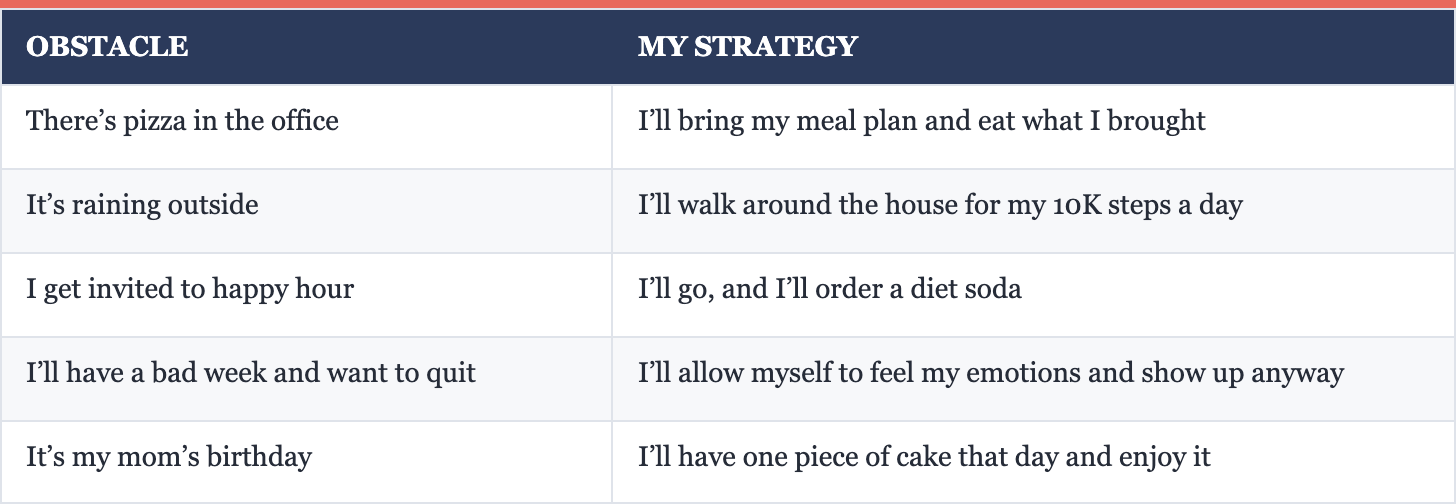
Notice the last one. Sometimes the strategy is “I’m planning for an exception and I’m not making it mean I failed.” Goals do not and should not mean you don’t enjoy the finer things in life like cake. 🎂
Keep going until you’ve got at least 10 to 15 obstacles and strategies. Include the ugly ones: “I’ll get bored in week three.” “My partner will order takeout.” Anything you can think of that might get in your way.
Part 4: What to do when if you fall off
If you never fall off, good for you honestly. 👏🏼 But you are most likely going to have a bad week at some point. Big goals take long enough that some weeks will objectively be harder than others.
Here’s my protocol.
Ask what you’d tell your friend. If your friend told you she missed 2 days of the gym, you would not tell her she’s lazy and should quit. You’d say “okay, no big deal, what’s the next thing?” Talk to yourself like that. Shame makes people quit, so don’t judge yourself.
Find the actual reason. When you fall off, get very curious about why. You want to be a scientist asking questions, not a critic handing down a verdict. Was the plan too aggressive? Did you not sleep? Were you white knuckling something unsustainable? Falling off is just data, it’s nothing personal and it’s not about who you are. It’s telling you where to adjust. You can even add it to your obstacle and strategy list if it wasn’t there already.
Set a minimum baseline. Decide right now what the bare minimum version of your goal looks like for a truly terrible week. The minimum baseline should be pretty damn easy. So if you originally said 10K steps a day, make your minimum baseline 5K. You shouldn’t need this minimum baseline often, but sometimes life throws multiple curveballs in the same week. Hit your 5K just to keep the identity alive.
Part 5: The three lies your brain will tell you, and how to answer them
Your brain is going to get real chatty around week three. Here’s what it’ll say and what to say back.
“You’ve already messed it up, may as well stop.” This is the all or nothing thing, and it’s the number one goal killer I’ve seen in years of working with women on this stuff. One bad day does not undo weeks of work. That’s not how bodies, money, or skills work. Instead think: “Nothing has gone wrong. I’m a person who gets back on track.”
“This is taking too long.” Compared to what? You made this timeline up. The work is the work and it takes as long as it takes. Instead think: “It’s taking exactly as long as it takes. It’s going exactly the way it’s supposed to go.” “I’m still on track, I just might need to adjust my plan.”
“You’re not the kind of person who does this.” I’m a math and science girl writing articles on the internet. I’m not the kind of person who used to do this, but I am becoming her. Instead think: “I’m becoming the kind of person who does this. I’m learning how.”
Part 6: Hold yourself accountable
Every week (pick a day), take a few minutes and run through these three questions:
What did I actually do this week toward my goal?
What got in the way, and was it on my obstacle list? If not, add it.
Is there anything I want to do differently next week?
That’s it. Add new obstacles as you discover them. Your list gets smarter every week, and after a month or two you basically have a personal instruction manual for your own brain.
Part 7: Look at it daily
Take your goal, your steps, and your obstacle list, and physically put them somewhere you’ll see them every day. Bathroom mirror, fridge, next to your desk. Look at it. Every. Single. Day.

Look, I set a goal that made zero sense for my skill set, I’m 973 subscribers away from it, and I’m doing it anyway. And honestly, I’ve grown and learned so much from it already and I’m not even at my deadline yet.
Drop your goal in the comments in this format:
By [date], I will [goal].
I read every single one and I promise I’m rooting for you.
We’re in this together. 💪